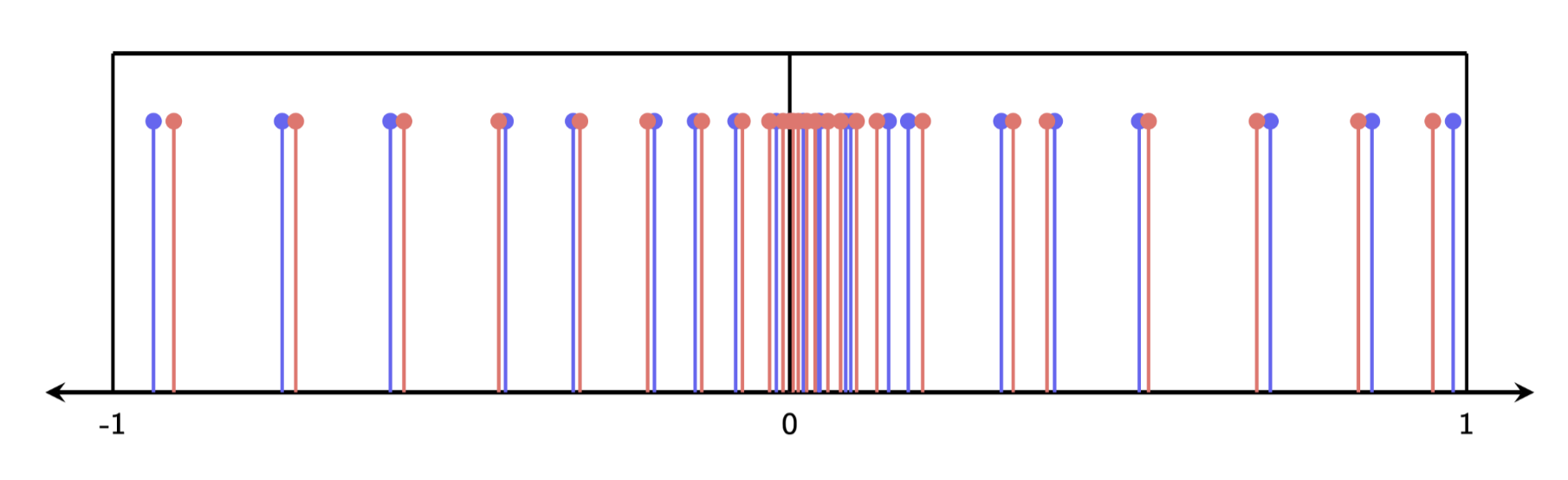
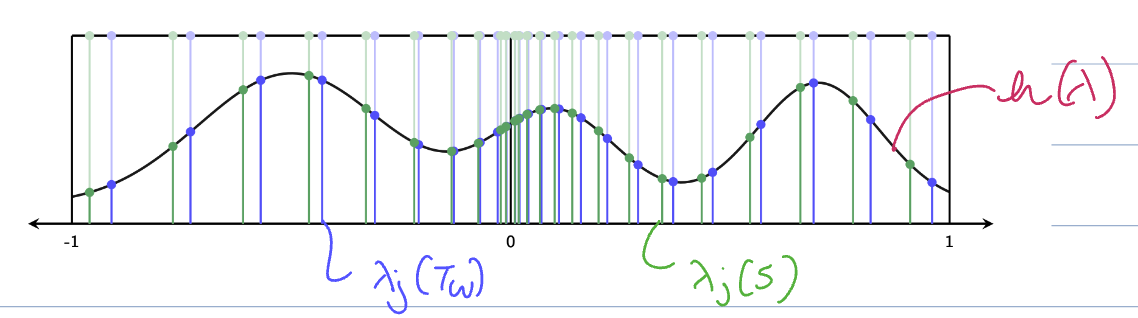
high variance of small samples might obscure important information in a signal's GFT, like the correlation with respect to the graph structure. Since the limiting [[graphon]] has no noise, it can reveal the "real"/intrinsic structure of the signal.
[[eigenvalues of the induced graphon converge pointwise to the eigenvalues of the limit]] ie for all
first approach: using convergence of signal and eigenvalues
Conjecture 1
Given the two above, it is reasonable to conjecture that the GFT converges to the WFT for all .
Recall that
In order to have convergence of the graph fourier transform]] to the [[graphon fourier transform]], we need {1||to}
Theorem (Davis-Kahan)
Let and be Hilbert-Schmidt operators with eigenspectra () and respectively ordered by [[eigenvalue]] magnitude. Then
Where is the [[operator norm]] and is defined as
Call the first interior min and the second
Example
corresponds to the minimum "eigengap" for the closes eigenvalue for eigenvalue in its own spectrum. Smallest
Note
If is large, then this is OK for fast convergence. But if this is small, then we also need small to get fast convergence.
see [[Davis-Kahan Theorem]]
Let . We can use the [[Davis-Kahan Theorem]] with (the limiting [[graphon shift operator]]) and ([[induced graphon]] shift operator).
This is good because from lecture 15, we know that if converges to in the converges to in (cut norm [[Convergence in the cut norm implies convergence in L2]]). Thus we have convergence in the numerator!
Does this mean everything is OK?
No! The denominator might vanish as since we have from the second part of the [[spectral theorem for self-adjoint compact operators on Hilbert spaces]]
even though we look at and converge to different values (and therefore ), it still might not work.
Even if we have eigenvalue convergence, this convergence is not necessarily uniform. (recall the difference between convergence and [[uniform convergence]]) because the graphon eigenvalues accumulate at 0.
Convergence holds in the sense that for all , there exists such that for all ,
However, will be different for each /eigenvalue (non-uniform convergence! we cannot fix a common for each )
Note
this is a limitation of graphons
for dense graphs this is useful
bounded spectrum
sparser graphs do not have convergence of spectra, so they are harder to deal with as well
Though the eigenvalues converge, they do not converge uniformly since their accumulation is at 0.
So conjecture 1 is wrong, but in the right direction
approach 2:
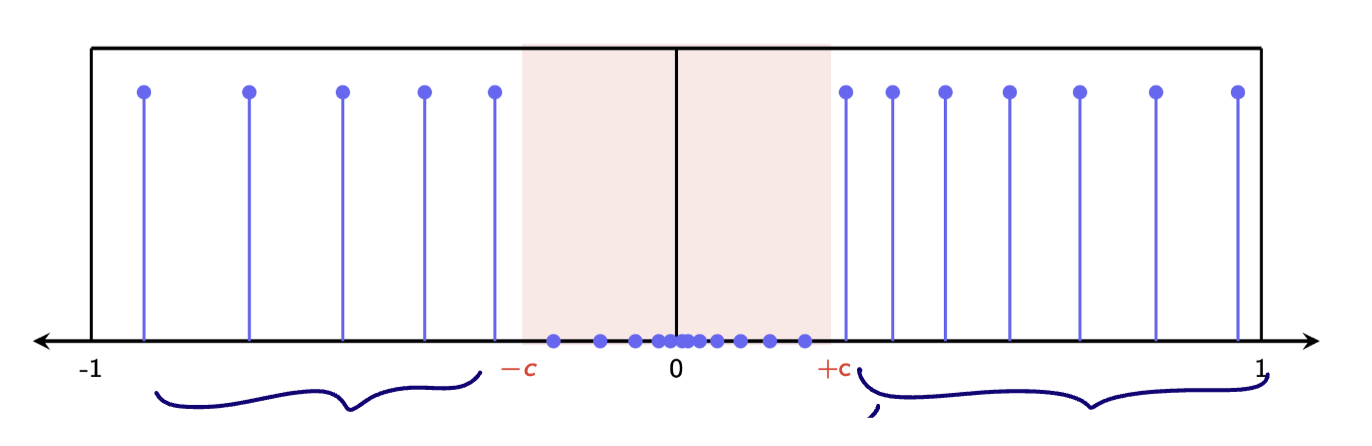
bandlimited graphon signal
A [[graphon signal]] is -bandlimited if its [[graphon fourier transform]] satisfies for all
see [[bandlimited graphon signal]]
Example
"Limiting" the energy to a middle "band" of frequencies about
Let be the set of eigenvalues in the -bandlimited set. Then for all , we have
By convergence of , for all , there exists some such that for all .
And for , we have
And from , for all , there is some such that for all
Thus, for any and each and for all , we have
And for ,
Where (orthogonal complement)
see [[bandlimited convergent graph signals converge in the fourier domain]]
Graphon Convolutions
WFT is the {1||algebraic equivalent} of GFT; graphon filters have the same {1||algebraic structure} of graph filters. These are the same {2||shift-and-sum} operations, but now the {2||shift} is the graphon shift
Graphon convolution
Given a [[graphon signal]] , we write the graphon convolution as the map
Like the WFT, the spectral response of a [[graphon convolution]] is discrete
the spectral response of the graphon convolution is also pointwise in that the th spectral component of the output only depends on and
ie depends only on and
The spectral response of given by is independent of the underlying (like the spectral response of was independent of the graph)
ie, the spectral response can be written as a polynomial function. The eigenvalues of the graphon determine where we evaluate this function. (samples of function that is eigenvalues/spectrum)
Given a [[convergent graph sequence]] , we know that
And if we fix coefficients , the [[graph convolution]] and the [[graphon convolution]] have the same spectral response (from above)
Theorem
Given and and , we have
in the sense that
the graph convolution converges to the graphon convolution (with the same filter coefficients) in the spectral domain.
This says
Convergence of the graph convolution to the graphon convolution in the spectral domain (first line)
Convergence of the spectral response of the graphon convolution on the induced graphon converges pointwise to the spectral response of the limiting graphon convolution (second line)
see [[the graph convolution converges to the graphon convolution in the spectral domain for a convergent sequence of graph signals]]
And this holds for all eigenvalue indices .
Problem though
Spectral convergence is not enough to do what we want. Graph convolutions operate in the node domain.
We'd like to use the Davis-Kahan Theorem to bound the distance between the eigenfunctions of the induced graphon shift operator and the limiting graphon shift operator to show convergence in the Fourier domain. Why does this fail? (2 reasons)
-?-
The denominator of the bound might vanish because as (the distances are getting smaller and smaller)
The eigenvalues only accumulate at 0. This means we may have non-uniform convergence in the eigenvalues
{1||bandlimited||condition} convergent graph signals converge {2||in the fourier domain.||result (how/where)}